PS · XBOX · PC · SW
Mina the Hollower takes the Game Boy Zelda template, points it at Dark Souls, and comes out the other side as one of the most confident action-adventure games of the year.

GAME FACTS
TIME TO COMPLETE (AVG)
23½ Hours
ACHIEVEMENTS
50
PUBLISHER
Yacht Club Games
DEVELOPER
Yacht Club Games
GENRES
Top-Down, Action, Open World
RELEASE YEAR
2026
Mina the Hollower — Review
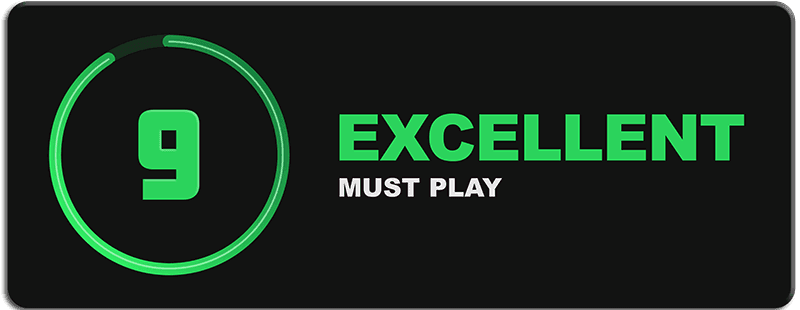
Score: 9/10
There's a specific kind of disappointment that comes with retro-styled indie games. You see the pixel art, you feel the nostalgia hook go in, and then you play for two hours and realise the game is coasting on the memory of something better. Mina the Hollower is the opposite of that. It uses the Game Boy Zelda template as a starting point and then spends twenty-five hours proving it has ideas of its own.
You play Mina, a mouse who returns home to the island of Ossex to fix the Spark Generators she helped invent, and finds the place overrun. The setup is standard — go here, relight the towers, uncover the thing that's obviously going wrong underneath it all. What isn't standard is how much personality Yacht Club have poured into the delivery. The NPCs are genuinely worth talking to. The town has a texture to it that most games at this scale skip entirely. It's a story you've broadly heard before, told by people who clearly cared about telling it.
The Burrowing
The hook is in the name. Mina can hollow into the ground, moving fast, ducking under attacks, crossing gaps that would otherwise stop you. It sounds like a dodge roll with a coat of paint. It isn't. It's a full traversal system, a defensive tool, and a combat rhythm all at once, and the game builds every encounter around the assumption you understand it.
That assumption is also where Mina will lose some people. The first four or five hours are genuinely hard, and not in a way that feels welcoming. You die a lot. You die to enemies you clip into by accident, you die to falls you thought you'd cleared, you die because you burrowed a half-second too late. There's a real learning curve here, and it's steep enough that I understand why some players bounce off before it clicks.
But it does click. Somewhere around the second tower, the whole thing snapped into focus for me and never let go. The combat is four-directional whip attacks plus sidearms, which sounds limiting until you realise how much space that leaves for reading enemy patterns. Bosses in particular are excellent — flashy, readable, demanding, and varied enough that I never felt like I was fighting the same fight twice with a different sprite.
Trinkets and the build system
The Trinket system is quietly the best thing in the game. These are equippable modifiers that reshape how you play, and finding the one that solves your particular problem is enormously satisfying. I struggled with platforming precision, found a Trinket that eased it, and kept it equipped for the rest of the run. Someone else will find one that fixes their combat spacing and never take it off either. It's a build system disguised as collectibles, and it means two people can finish this game having played it quite differently.
There are also difficulty modifiers, which I want to give Yacht Club real credit for. They're generous, they're not hidden away in a menu you have to feel bad about opening, and they mean the game's punishing default doesn't have to be a wall. If the first few hours are grinding you down, turn something on. The game is still worth playing.
What holds it back
The hollowing, for all it does, never becomes fully precise. Even at the end I was still occasionally burrowing into a hole I didn't mean to enter, or coming up a beat out of position. Some of that is old-school design intent. Some of it is just imprecision, and after twenty-plus hours it grated.
There's also a stretch in the middle where the density of new ideas dips slightly and the difficulty carries more of the load than it should. It's brief, and the game recovers, but it's there.
Who this is for
If you loved Link's Awakening and you also loved Dark Souls, this is your game, immediately, without qualification. If you loved one but not the other, you'll probably still get there — just know which half you're signing up for. If you have no patience for a game that expects you to lose repeatedly before you improve, Mina will frustrate you, and no amount of pixel art charm will fix that.
For everyone else, this is one of the most confident, most complete action-adventure games of the year. It looks backwards and moves forwards at the same time, which is far harder than it sounds.